What do I need to make Spells?
Welcome, dear reader. I’m Amira Asmodea, here to walk you through the heart of spellcraft—what you’ll need to begin weaving your magic with intention and care. The truth is, spellmaking isn’t about fancy gadgets or mysterious artifacts gathered from distant lands, although those can be beautiful. It’s about holding a space and using items that help you focus your energy, connect with your spirits, and ground your intention. Let’s unpack this together, with kindness and clarity.
Setting Your Sacred Space: The Altar
Altar
In my experience, the altar is often where witchcraft breathes and lives. Think of it as your magic’s home, a flat space or table where ritual energy flows and intentions take shape. Many practitioners have two altars: a permanent altar as a center for devotion and spiritual reminder, and a working altar that changes with each spell or ritual.
Your altar’s appearance and contents are deeply personal. Some are adorned with images or statues representing deities or spirits dear to you; others hold natural objects like stones, feathers, or seashells that speak to your soul. There’s no right or wrong—only what resonates. This is your sacred corner, so arrange it to reflect your path and your heart.
Tools for Directing Energy and Intention
Athame
You might picture a sharp dagger when you hear “athame,” but its purpose is quite different. This ritual knife, typically black-handled and double-edged, is never slipped into anything physical—its sharpness cuts only through the unseen energies around you. In traditional magic systems, it represents the element of Air (or sometimes Fire) and helps you command your circle’s boundaries. Before casting a spell, many witches trace a magic circle with the athame to create a protected space where energies can rise and be shaped.
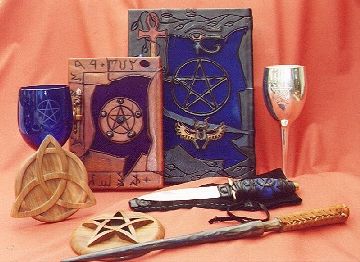
Boline
Think of this as your practical knife, usually sporting a white handle to mark it apart from the athame. The boline is used for cutting herbs, ribbons, or even carving symbols into wood or candles. It bridges the spiritual and the physical, helping you prepare your ingredients for magic.
Magic Wand
Wands and athames share the role of directing energy but often differ in symbolism. While the athame represents air or fire, the magic wand is commonly linked to fire’s creative spark. Typically made from wood, a wand is a personal project—you might carve or decorate it with sigils or symbols meaningful to you. Using a wand feels like channeling your will through a focused pointer, shaping the invisible threads of magic.
Tools of Sound and Movement
Campaign
Sound is a powerful portal into the spirit realm and our inner worlds. Campaigns—or ritual drums—are used to call positive energies, awaken spirits or deities, and mark transitions during rituals. Their deep, resonant tones naturally shift our mental state into one more open to magic. When drums aren’t available, bells perform a similar function, their clear chiming lifting and clearing the atmosphere.
Broom
The humble ritual broom, often crafted from birch or willow, might remind you of the witch’s classic tool. But its magic is subtle—it doesn’t sweep dust like in everyday cleaning. Instead, it symbolically brushes away negativity and unwanted energies. In my practice, the broom hovers just above the surface, gently pushing out dark feelings or distractions. Visualization is essential here—you imagine sweeping away all that doesn’t serve your magic or your heart.
Containers of Transformation
Boiler
Forget the bubbling potion cauldron of fairy tales—today’s witch thinks of the boiler, or cauldron, as a vessel for transformation. It can be a small iron pot with legs, holding water for divination, flowers soaking to release their essence, or sacred items related to the spell you’re weaving. It’s a tool of change, where energies mingle and shift. When heat-resistant, it can safely hold small fires for burning papers or offerings, acting as an altar centerpiece.
Chalice
The chalice is your liquid companion during ritual—a cup with a stem, often holding water but sometimes wine, tea, or other meaningful drinks. Made from any material you love—silver, brass, glass, or pottery—it represents the element of Water and invites feelings of flow, intuition, and emotional balance into your work.
Other Practical Materials to Gather
Many spells rely even more on simple, everyday items than on symbolic tools. These often hold the real magic because you imbue them with meaning and attention.
- Jars and Bottles: For potions, storages, or spell mixes
- Rope and Yarn: Used in binding spells or creating talismans
- Candles: A vital source of light and energy; color and scent add layers of intent
- Herbs and Flowers: Nature’s medicine and magic, each with its own spirit and use
- Mortar and Pestle: For grinding herbs, blending powders, or activating mixes
- Crystals and Stones: Earth’s energy, grounding and amplifying spellwork
- Mirrors: Tools for divination, scrying, or reflecting energies
- Feathers and Shells: Air and water connections, often used in ceremonies
- Tarot and Oracle Cards: For guidance and unlocking intuition
- Incense: Invokes spirits, purifies space, and elevates the mood
- Oils: Carried on candles, applied to tools, or worn to anoint
- Pendulums: For simple divination or yes/no answers
- Dolls and Figurines: Representations in sympathetic magic
- Paper and Magazines: For writing intentions, sigils, or cutting images
- Bags and Sachets: Containers infused with herbs or crystals for protection or luck
- Salt and Sand: Traditional purifiers and markers of boundaries
- Personal Items: Such as hair, nails, or even small amounts of bodily fluid, for connection in spellwork through sympathetic magic
Questions Readers Often Ask
Do I need all these tools to get started? Not at all. In fact, many witches begin simply with what they already have—candles, herbs from the garden, a favorite cup for a chalice. Magic is about intent and mindfulness, not owning every traditional item. Gather what calls to you and suits your practice.
Can I create my own tools? Absolutely. Making your own wands, altars, or even ritual brooms can deepen your connection to your craft. It’s the care and purpose you bring that matters most.
What if I don’t have an altar space? Your altar can be as small as a window sill or a shelf. Some practitioners use portable altars—boxes or bags that hold their tools and can be set up and put away each time. Flexibility is part of the magic.
How do I know which herbs or candles to use? Traditionally, herbs and candle colors correspond to specific intentions—lavender for calming, green candles for abundance, for example. But what truly matters is your personal connection. If a certain scent or shade feels right, follow that feeling.
Closing Thoughts
Magic is a dance between the seen and unseen, your heart and the world around you. The tools I’ve described are companions on your journey, but they can’t conjure magic without your intent. Take your time, invite your intuition, and let your practice shape itself as you grow. May your altar be a place of peace, your spells be filled with light, and your craft be ever nourishing.
Thank you for sharing this moment with me. If you’d like to explore more about spells, rituals, or the many faces of witchcraft, keep reading here with me at Amira Asmodea.
Bibliography
- Cunningham, Scott. Earth, air, fire & water. Llewellyn Publications, 1991. Source.
- Doreen Valiente. Natural Magic. Robert Hale, an imprint of The Crowood Press, 1975. ISBN 9780719826924. Source.
- Buckland, Raymond. Buckland's Complete Book of Witchcraft. Llewellyn Publications, 1986. ISBN 9780875420509. Source.
- Scott Cunningham. Wicca: a guide for the solitary practitioner. WICCA A GUIDE FOR THE SOLITARY PRACTITIONER SCOTT CUNNINGHAM Llewellyn Publications, 1993.
- Knight, Gareth. A History of White Magic. Illustrated reprint, Skylight Press, 2011, 207 pp. ISBN 9781908011046. Google Books.